Mexico City: Where to Stay and a Neighborhood Food Map
Fact-checked July 17, 2026 · 7 sourcesHow we verify
Mexico City rewards travelers who decide one thing before they book anything else: which neighborhood they want to wake up in. Get that right and the city feels walkable, cheap, and endlessly edible. Get it wrong and you spend the trip in Ubers. This is a research guide to making that call — where to stay, what to eat in each area, how to fit in the Teotihuacán pyramids, and roughly what it all costs.
This is a sourced research post. The durable stuff — neighborhood character, which foods cluster where, how the day trip works — is written at the area and dish level, not pinned to single restaurants that open and close. The volatile stuff — prices, hours, fares, entry fees, and the safety advisory level — is marked "approx." and should be reconfirmed at the official sites in Sources before you book or travel.
First, pick your base — neighborhood before hotel
Mexico City is enormous, but the slice most first-time visitors actually use is small and well-connected: a triangle of Roma Norte, Condesa, and Centro Histórico, with Polanco and Coyoacán as optional add-ons. Choose the base that matches your trip and you can walk to most meals and Uber the rest in 15–20 minutes.
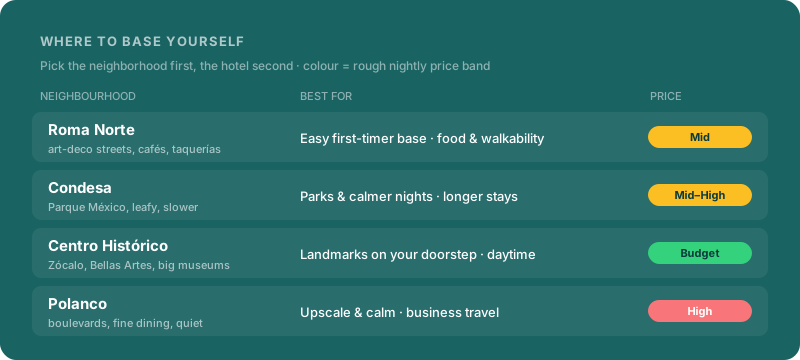
| Neighborhood | Vibe | Best for | Nightly price band |
|---|---|---|---|
| Roma Norte | Art-deco streets, cafés, taquerías | Easy first-timer base; food + walkability | Mid |
| Condesa | Leafy, calm, built around two parks | Parks, calmer nights, longer stays | Mid–High |
| Centro Histórico | Grand plazas, big museums, landmarks | Daytime sightseeing on a budget | Budget |
| Polanco | Boulevards, fine dining, quiet | Upscale and calm; business travel | High |
| Coyoacán | Cobblestones, markets, local pace | A slower, local feel on a longer trip | Mid |
Price bands are relative and seasonal — confirm current rates before booking.
Roma Norte — the easy first-timer base
If you only read one line: book Roma Norte for your first trip. It is central, walkable, packed with cafés and restaurants, and widely flagged as one of the safer, more comfortable areas for visitors. It is the area most guides nudge first-timers toward, especially food-focused ones. The downside is that "discovered" pricing has caught up — it is no longer the bargain it was five years ago.
Condesa — parks and calmer nights
Condesa sits right next to Roma and trades a little of the restaurant density for greenery and quiet. The neighborhood wraps around Parque México and Parque España, which give it a residential, slip-into-the-rhythm feel that suits longer stays. Pick Condesa if you want tree-lined mornings, brunch culture, and calmer nights, and you do not mind a short walk into Roma for dinner.
Centro Histórico — landmarks on your doorstep
Centro Histórico is the Mexico City of the postcards: the Zócalo, the Catedral Metropolitana, Templo Mayor, the Palacio de Bellas Artes, and a cluster of the city's biggest museums, all within walking distance. Hotels here run noticeably cheaper, and for a short, sightseeing-heavy first visit it is the most efficient base. The trade-off is atmosphere after dark — Centro is brilliant by day but emptier and best navigated by Uber at night.
Polanco and Coyoacán — when they make sense
Polanco is the upscale, quiet option: wide boulevards, luxury hotels, and the city's headline tasting menus. Choose it for comfort or business, not for street-level buzz. Coyoacán is the opposite end — cobblestone, slow, and local, with the Frida Kahlo Museum and a great market. It is a wonderful base only if you have extra days and want a calmer, residential pace away from the Roma–Condesa core.
Do not hop hotels every two nights. Even on a 6–7 day trip, one base in the Roma–Condesa–Centro triangle plus day trips is easier on your legs, your luggage, and your budget than constant moves.
The neighborhood food map — what to eat where
Mexico City's food scene is too deep to memorize restaurant by restaurant. The trick is to remember it the way locals navigate it: by what you're eating and which neighborhood does it best. Markets and street stands matter as much as the sit-down spots — the city has more than 300 public markets (around 329 by the city's own count).
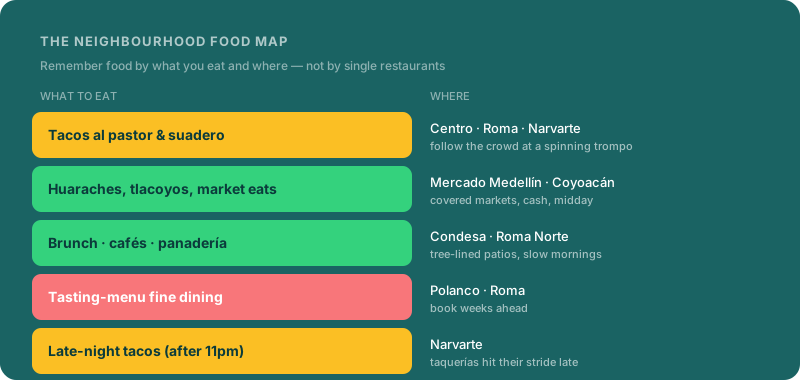
| What to eat | Where it's best | One-liner |
|---|---|---|
| Tacos al pastor & suadero | Centro, Roma, Narvarte | Follow the crowd around a spinning trompo; busy stands = fresher meat |
| Huaraches, tlacoyos, market eats | Mercado Medellín (Roma), Mercado de Coyoacán | Covered markets, cash, best at midday |
| Brunch, cafés, panadería | Condesa, Roma Norte | Tree-lined patios and slow mornings |
| Tasting-menu fine dining | Polanco, Roma | The big-name kitchens; book weeks ahead |
| Late-night tacos (after 11pm) | Narvarte | Taquerías hit their stride late; this is where locals go |
A few practical notes. Mercado Medellín in Roma and the Mercado de Coyoacán are the most visitor-friendly market introductions — go hungry, bring cash, and graze. The serious neighborhood food is often outside the tourist triangle: Narvarte is less touristy than Roma or Condesa and is the city's late-night taco heartland. And many of the best taquerías don't peak until 7–8pm or later, so plan dinners late and lunch big.
Specific stalls and restaurants change constantly — opening hours, lines, even whether they still exist. Treat any named spot as a starting point and check a maps app for current hours before you go.
Teotihuacán — the one day trip to plan around
The pyramids of Teotihuacán sit about 50 km (31 miles) northeast of the city and are an easy, rewarding self-guided day trip — no tour required. The single most important rule is go early: you beat the heat, the crowds, and (in the rainy summer months) the afternoon storms.
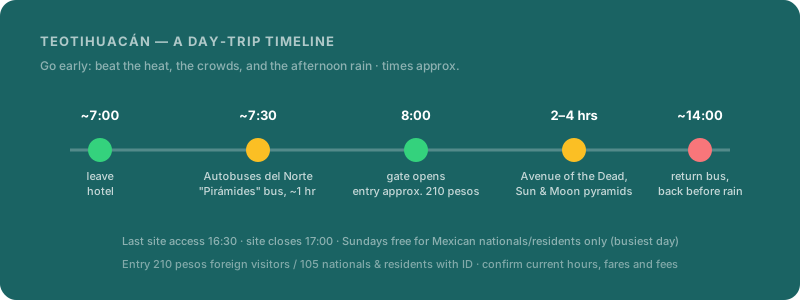
Getting there without a tour. Buses to the pyramids leave from the Autobuses del Norte terminal (its own Metro stop on Line 5). Look for the ticket window marked "Pirámides" toward the northern end of the terminal. Departures run roughly every 15 minutes from early morning, the ride is about an hour, and the fare is approx. 50–70 MXN each way (about US$3–4 per ride), paid in each direction — there's usually no round-trip ticket, so budget roughly 100–140 MXN for the return. An Uber from Roma/Condesa is the comfortable alternative at roughly 60–90 minutes depending on traffic.
Hours, fees, and climbing. Per the official INAH listings, the site is open daily 08:00–17:00 with last access at 16:30.
On admission, watch out for the thing that trips up most write-ups of this site. The official INAH page lists two numbers — 105 MXN and 210 MXN — without labelling either one, and they are not a gate price and an online price. They are visitor categories. Under the fees in force since 1 January 2026:
- Foreign visitors pay approx. 210 MXN (about US$12).
- Mexican nationals, and foreigners holding Mexican residency, pay approx. 105 MXN on presenting valid official ID.
So if you are visiting on a tourist entry, budget 210 MXN — buying online doesn't change it. Climbing access changes for conservation and is not guaranteed: as of 2026 the Pyramid of the Sun is closed to climbing, while the Pyramid of the Moon reopened in May 2025 but only for its lower (first) section. Check the "daily access status" posted at the ticket booths when you arrive. Sunday free admission applies only to Mexican nationals and residents with valid documents — not to foreign tourists — and it makes Sunday the most crowded day to visit anyway.
| Item | Approx. (confirm before travel) |
|---|---|
| Site hours | 08:00–17:00, last access 16:30 |
| Entry fee — foreign visitors | ~210 MXN (~US$12) |
| Entry fee — Mexican nationals/residents | ~105 MXN with valid ID |
| Bus (Autobuses del Norte, each way) | ~50–70 MXN (~100–140 round-trip) |
| Uber from Roma/Condesa (one-way) | ~60–90 min, varies with traffic |
| Time on site | 2–4 hours typical; up to a full morning |
Bring water, sun protection, and a hat — Teotihuacán is exposed and the high-altitude sun is strong. These figures move; reconfirm hours, fares, and fees at the official site before you go.
When to go and what it costs — a rough budget
Mexico City's tourism calendar has a few clear peaks — jacaranda/spring (March–April), Día de los Muertos (late October to Nov 2), and Christmas–New Year — and quieter, cheaper stretches around them. The summer rainy season (roughly June–September) is the off-peak value window, when flights and hotels soften; we break that case down in our companion post on Mexico City in August.
Below is a directional per-person budget for a ~5-day trip, mid-range, outside the peak weeks. Treat it as a starting estimate, not a quote — flights and hotels are the swing factors and depend heavily on season and how far ahead you book.
| Item | Approx. per person (5 days) | Note |
|---|---|---|
| Round-trip flight (from US gateway) | US$200 – 380 | Lower in summer shoulder, higher at peaks |
| Hotel, Roma/Condesa boutique (4 nights) | US$440 – 640 | Centro Histórico runs cheaper |
| Food (street + mid-range, 5 days) | US$120 – 250 | Easy to spend less leaning on markets/tacos |
| In-city transit (Uber/Metro/Metrobús) | US$40 – 80 | Metro/Metrobús fares are a few pesos a ride |
| Teotihuacán day trip | US$18 – 30 | Self-guided: ~210 MXN entry + ~100–140 MXN buses; more if you take a tour |
| Museums & sights | US$20 – 60 | Most museums are only a few US dollars |
| Rough total (excl. flight) | US$638 – 1,060 | Flights on top; FX-dependent |
Exchange rates and seasonal pricing move these numbers a lot. Re-run the math at current FX right before you book, and confirm hotel rates for your actual dates.
To line this trip up against your own holidays — and to see how few PTO days a bridge could cost you — run your dates through the free leave optimizer. If you're a Mexico-based reader, our Mexico annual-leave rights guide covers what you're entitled to.
Getting around and staying safe
Within the Roma–Condesa–Centro–Polanco core, walking plus Uber/Didi covers almost everything; rideshare is cheap and the default after dark. The Metro and Metrobús are fast and cost only a few pesos per ride, but they get crowded — watch your pockets at rush hour.
On safety: the US State Department currently rates Mexico City (CDMX) at Level 2 — "Exercise increased caution," the same level it assigns to several Western European countries. In practice, central tourist neighborhoods are comfortable by day, the most-cited risks are pickpocketing on the Metro and street-taxi scams (use Uber/Didi instead of hailing taxis), and the standard advice is to stick to the well-trodden neighborhoods and avoid peripheral areas after dark. Advisory levels change — check the current advisory before you travel.
One more thing first-timers underestimate: altitude. The city sits at about 2,240 m (7,350 ft). Most people feel only mild effects for a day — easier dehydration, lower alcohol tolerance, a little breathlessness on stairs. Drink extra water, go easy on the first night's mezcal, and don't schedule anything strenuous on arrival day.
Frequently asked questions
Roma or Condesa — which should I book?
Both are excellent and walkable to each other. Choose Roma Norte if you want the liveliest, most restaurant-dense first-timer base. Choose Condesa if you'd rather have parks, quieter nights, and a residential feel, especially on a longer stay. You genuinely can't go wrong; pick on vibe, then on price for your dates.
How many days do I need in Mexico City?
Three to four days covers the core: a neighborhood base, Centro Histórico, the National Anthropology Museum, and one big meal out. Five to seven days lets you add Teotihuacán, Coyoacán, Xochimilco, and a slower food crawl without rushing. Most first-timers are happiest around five.
Is Mexico City safe for tourists?
The central, well-trodden neighborhoods — Roma, Condesa, Polanco, Coyoacán, Centro Histórico by day — are comfortable for visitors, and CDMX currently carries a Level 2 US advisory. The practical risks are petty: pickpocketing on the Metro and taxi scams. Use Uber or Didi instead of street taxis, keep valuables low-profile, and confirm the current advisory before you go.
Can I do Teotihuacán without a tour?
Yes. Take a "Pirámides" bus from the Autobuses del Norte terminal (it has its own Metro stop), arrive early, pay the entry fee at the gate, and return on the same bus line in the afternoon. Budget roughly 210 MXN entry (the foreign-visitor rate — the lower 105 MXN rate is for Mexican nationals and residents only) plus about 100–140 MXN of bus fare. A tour adds a guide and door-to-door transport but isn't necessary to see the site well.
Sources
- Lonely Planet — guide to Roma and Condesa — neighborhood character and who each suits
- INAH — Teotihuacán (lugares.inah.gob.mx) — official hours and admission (note: lists 105 and 210 MXN without labelling which is which)
- Infobae — INAH 2026 admission tariffs — which fee applies to nationals/residents vs foreign visitors, effective 1 Jan 2026
- El Universal — cost of entry to Teotihuacán in 2026 — corroborates the 105/210 national-vs-foreigner split
- INAH — Zona Arqueológica de Teotihuacán (official site) — official site information
- Mexico City government tourism — Teotihuacán — official city venue/transport info
- US State Department — Mexico Travel Advisory — current advisory level for CDMX
- ROADBOOK — best street food and markets in Mexico City — dishes, markets, and which neighborhoods do them
Prices, hours, fares, entry fees, and the safety advisory level change frequently. Reconfirm everything at the official sources above before booking or traveling.
Next Step
Match this trip idea to your PTO
See which holiday windows make this trip easiest to book, then set reminders before prices move.
Plan this trip windowGet booking-timing and PTO planning emails
Related topics
Useful tools
Related Articles
Flight Delay Compensation, US vs EU: Who Actually Owes You Cash — EU261, UK261, DOT Refunds, and Canada's APPR
The same three-hour delay can be worth 600 EUR in Europe and zero dollars in the US. A research breakdown of EU261's fixed compensation tiers, the UK's post-Brexit clone, the US DOT automatic-refund rule, and Canada's APPR — plus how to file and the claim deadlines by country.
Annual vs. Per-Trip Travel Insurance: The Break-Even Math Nobody Shows You
How many trips per year does it take before an annual multi-trip travel insurance policy beats buying per-trip? The break-even formula, worked examples at realistic premium ranges, the per-trip length and cancellation caps annual plans hide in the fine print, and when your credit card already fills the gap.
The Best Time to Book International Flights: What the Booking-Window Data Actually Shows
Google Flights, Expedia/ARC, and Hopper publish real booking-window data — and they don't fully agree. A data-driven look at how far ahead to book by region, why the 'book on Tuesday' myth fails while the day you fly genuinely matters, and a price-alert workflow that beats any magic date.