How Long Is Lunar New Year? Public-Holiday Length by Country (and How to Leverage It)
Fact-checked July 17, 2026 · 9 sourcesHow we verify
"How long is Lunar New Year?" has no single answer — it depends entirely on which country's labor calendar you're standing in. The same astronomical new moon triggers a two-day public holiday in Singapore, a three-day one in South Korea, and a seven-to-eight-day national shutdown in China. This post compares the statutory length country by country, explains the two mechanics — make-up weekends and substitute holidays — that stretch a short holiday into a long one, and shows how to add your own paid leave for maximum leverage.
This is a research piece written with sources. The structure of each holiday (how many statutory days, and how they get extended) is stable and is what we compare here. The exact dates and golden-week windows shift every year — China's official schedule isn't even confirmed until the November before — so we hedge every date and hand the precise math to the leave optimizer. Verify current-year dates on the official sources in Sources before booking.
The short answer: statutory days by country
Lunar New Year is a single festival, but the paid public holiday attached to it ranges from 2 to about 8 days. Here is the comparison at a glance.
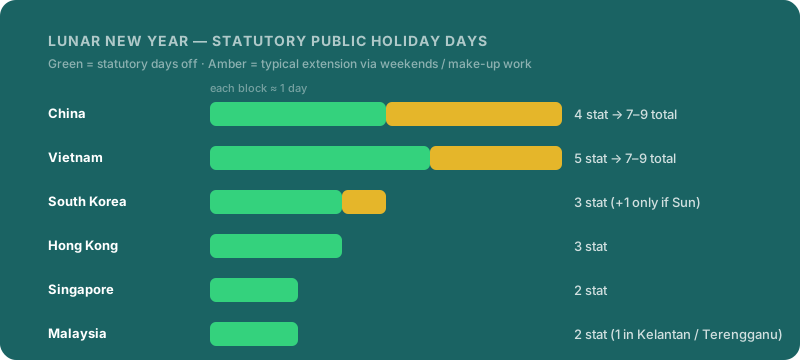
| Country | Statutory public-holiday days | Typical continuous break | Extension mechanism |
|---|---|---|---|
| China | 4 (raised from 3 in 2025) | 7–9 ("Spring Festival Golden Week") | Make-up weekends (调休) |
| Vietnam | ~5 (Tet) | 7–9 | Adjacent weekends + government-declared bridges |
| South Korea | 3 (eve, day, day-after) | 3–5 | Substitute weekday only if a day falls on a Sunday (Saturday does not count) |
| Hong Kong | 3 (days 1–3) | 3–4 | Rolls forward if it clashes with a Sunday |
| Singapore | 2 | 2–4 | Monday off if a day falls on Sunday |
| Malaysia | 2 (1 in Kelantan & Terengganu) | 2–4 | Adjacent weekend |
Two things jump out. First, the headline "length" of Lunar New Year is mostly a policy choice, not a cultural one — Chinese, Korean, Vietnamese and Singaporean families all celebrate for roughly two weeks traditionally, but the paid days off differ by a factor of four. Second, the countries with the shortest statutory holidays (Singapore, Malaysia, Hong Kong) are exactly where your own paid leave does the most work — there's the most "room" to bridge.
Mechanic #1 — China's make-up weekends (调休)
China's headline number confuses people: the Spring Festival is usually described as a seven- to nine-day holiday, yet the statutory entitlement is only four days (raised from three at the start of 2025, when Chinese New Year's Eve was added as a paid day). Where do the rest come from?
They are borrowed from weekends. Under the 调休 (tiáo xiū) system, the State Council designates the days around Spring Festival as continuous days off, then requires employees to work an adjacent Saturday or Sunday to "pay back" one or two of them. The net result is a single unbroken 7–9 day run, but the worker has spent zero personal leave to get it.
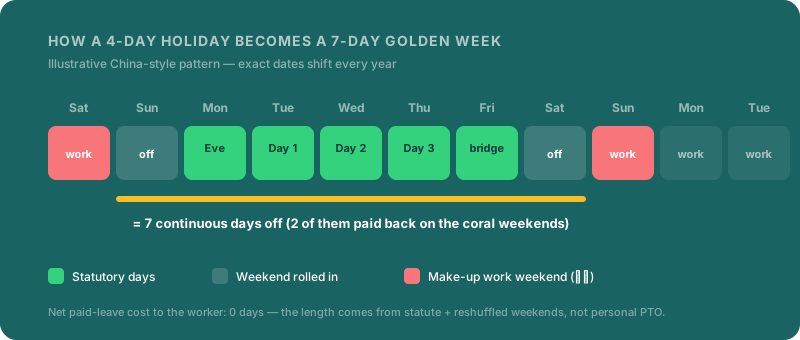
The important consequence for planning: China's "7-day holiday" is not 7 free days. If you compare it to a Western country's PTO, the honest equivalent is closer to the 4 statutory days, because the rest is time you'll work back on the flanking weekends. The 2027 schedule is not final until around November 2026 — the State Council publishes each year's adjustment calendar the preceding November — so treat any 2027 window you see now as provisional.
Vietnam runs a looser version of the same idea. Tet has roughly five statutory days, and the government commonly declares extra bridge days to knit them to the surrounding weekends, which is how Tet routinely lands at 7–9 continuous days in practice.
Mechanic #2 — Korea's substitute holiday (대체공휴일)
South Korea takes a cleaner approach. Seollal is a fixed three-day holiday — the day before, the day itself, and the day after. Since 2014, if one of those three days falls on a Sunday, the government grants a substitute holiday (대체공휴일) on the next available non-holiday weekday.
The crucial catch: Saturday does not count. This is the single most misreported detail about the Korean holiday calendar, and plenty of English-language "holiday calculator" sites get it wrong. Under 관공서의 공휴일에 관한 규정 제3조, the Seollal and Chuseok clusters earn a substitute only when they collide with a Sunday or another public holiday — and Saturday is not a 공휴일 in Korean law. Children's Day is the holiday that triggers on Saturday; Seollal and Chuseok never have.
The consequence is concrete: if Seollal day itself lands on a Friday, the cluster runs Thursday–Saturday, that Saturday is simply absorbed with no compensation, and you get four days off instead of five. Real example: Chuseok 2026 runs Thu 24 – Sat 26 September and receives no substitute holiday at all, precisely because it clips a Saturday rather than a Sunday.
So Seollal's continuous length swings between 3 and 5 days depending on the year's weekday alignment, with no make-up work required. It is still the least demanding of the three systems for a salaried worker — you never work a day back — but it is not a guarantee that the weekend can't eat a day of your holiday. It only protects you from Sundays.
For the full statutory-leave context around this — annual leave accrual, the 15-day baseline under the Labor Standards Act, and how Seollal stacks with your paid days — see our South Korea annual leave rights guide.
Which one gives you the most days off?
Statutory length is only half the story. What a traveler or remote worker actually cares about is the leverage ratio: total consecutive days off ÷ personal leave days you spend. And here the short-holiday countries can beat the long-holiday ones, because a short holiday landing mid-week leaves obvious bridges.
- China / Vietnam: low personal leverage. The break is long, but it's engineered by statute and make-up weekends; adding your own PTO on top just extends an already-long shutdown when everything is closed and expensive.
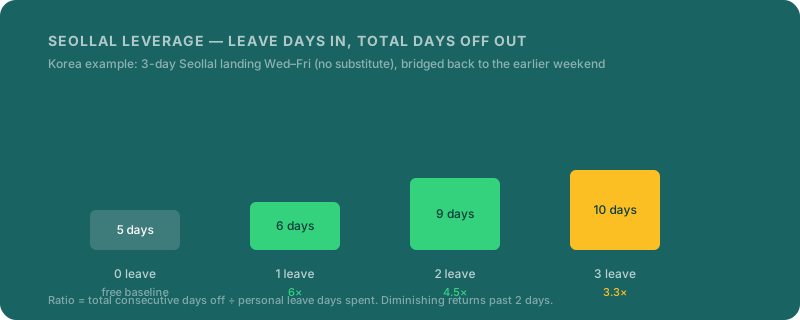
- South Korea: high leverage. A 3-day Seollal landing mid-week is a textbook bridge target — a Wed–Fri cluster already carries the following weekend for free (5 days at zero cost), and 2 leave days stretch that to 9.
- Singapore / Malaysia / Hong Kong: highest leverage. With only 2 statutory days, a single well-placed leave day frequently buys a 4–5 day weekend.
A worked example — 2 leave days at Seollal
Take a mid-week Seollal — say the three statutory days land Wednesday–Friday (weekday alignment shifts yearly; let the optimizer place the real dates). Note that this alignment puts Seollal itself on a Thursday, so no day touches a Sunday and no substitute holiday is generated.
- Statutory holiday: Wed, Thu, Fri, and the weekend after (Sat–Sun) is already attached — so you start from 5 consecutive days off for 0 leave. This is your true baseline; don't pay for days you already have.
- Spend 2 personal leave days on the Monday and Tuesday before the holiday to reach back and connect the earlier weekend (Sat–Sun).
Result: Sat, Sun, Mon, Tue, Wed, Thu, Fri, Sat, Sun = 9 consecutive days off for 2 leave days spent — a 4.5× leverage ratio on the headline measure (9 ÷ 2).
Be honest about the marginal gain, though: since 5 of those days were free anyway, the 2 leave days actually bought you 4 extra days — 2 days of freedom per leave day. Push to 3 leave days (adding the following Monday) and you reach 10 days, dropping the headline ratio to 3.3×; a 4th leave day gets you 11 days at 2.75×. That's classic diminishing returns, and two days is usually the sweet spot.
The exact bridge depends entirely on which weekday Seollal lands on this year, and whether a substitute holiday shifts it. Don't eyeball it — drop your country and this year's dates into the leave optimizer and it will find the cheapest bridge for you.
Planning implications
- Booking flights/hotels: the countries with the longest statutory breaks (China, Vietnam) are also the most crowded and most expensive to travel within or out of — the whole country moves at once. If you're flexible, traveling into a Lunar-New-Year country during a different country's ordinary week is often cheaper and quieter.
- Coordinating across borders: a 2-day Singapore holiday and a 7-day China Golden Week overlap only partially, which is a headache for regional teams. We break this down in Lunar New Year for global teams.
- Comparing to the West: don't be dazzled by "7-day holiday" headlines. On a like-for-like paid basis, adjust China down for make-up weekends. For a broader baseline, see our average PTO by country comparison.
Frequently asked questions
Is Lunar New Year the same length everywhere?
No — that's the whole point. Statutory paid days range from 2 (Singapore, Malaysia) through 3 (Hong Kong, South Korea) and 4 (China) up to 5 in Vietnam, which has the most statutory Tet days of any country here. China's 4 is then stretched into a 7–9 day continuous "Golden Week" by make-up weekends, so China has the longest continuous break without having the most statutory days. Traditional family celebrations run about two weeks almost everywhere, but the paid public holiday is a policy choice that differs by country.
Why is China's "7-day" holiday not really 7 free days?
Because only 4 of those days are statutory and the rest are borrowed from weekends under the 调休 make-up system. Employees typically work an adjacent Saturday or Sunday to pay back the extra days, so the break is continuous but not "free" in the way a Western PTO week is.
Does South Korea give a day back if Seollal falls on a weekend?
Only if it falls on a Sunday. Since 2014, Korea's substitute holiday (대체공휴일) rule grants an extra weekday off when one of the three Seollal days collides with a Sunday or another public holiday — but Saturday does not trigger it. If Seollal day lands on a Friday, the cluster runs Thu–Sat and that Saturday is lost with no compensation. (Children's Day is the holiday that does trigger on a Saturday; Seollal and Chuseok do not.) Chuseok 2026, running Thu 24 – Sat 26 September, gets no substitute day for exactly this reason. This is why Seollal's continuous length varies from 3 to 5 days year to year.
How many of my own leave days should I add?
For short-holiday countries, 1–2 leave days usually gives the best leverage (often 4–5× days off per leave day). Beyond two days you hit diminishing returns. The exact bridge depends on the year's weekday alignment — use the optimizer to size it precisely.
Sources
- China 2026 Public Holiday Schedule (Spring Festival = 4 statutory days + make-up workdays) — China Briefing
- Golden Week (China) — PublicHolidays.cn
- Tet 2026, 2027 and 2028 — PublicHolidays.vn
- Korean New Year (Seollal), three-day holiday — Wikipedia
- 관공서의 공휴일에 관한 규정 제3조 (substitute-holiday rule: 설날/추석 trigger on Sunday or another public holiday; 어린이날 also on Saturday) — 국가법령정보센터
- 설날·추석 연휴 및 어린이날 대체공휴일 확정 (original 2013 rule, first applied 2014) — 행정안전부
- Public Holidays for 2027 — Singapore Ministry of Manpower
- Chinese New Year 2027 and 2028 — PublicHolidays.com.my
Holiday dates and golden-week windows shift every year, and China's official schedule is confirmed only the November before. Always confirm the current year's dates on the official sources above, and let the optimizer place the exact bridge for your country.
Next Step
See your own best PTO windows
The article gives you the strategy. The optimizer gives you the exact dates for your year and your PTO balance.
Find my windowsGet the calendar and return when you are ready
Related topics
Useful tools
Related Articles
The Global PTO Gap: Why Workers Take Far Less Leave Than They're Entitled To
In most countries, workers leave a significant chunk of their paid leave unused. Here's the data on the gap between statutory entitlement and actual usage across 18 countries -- and what drives it.
Which Countries' Workers Use the Least Leave? A Global Ranking of Unused Vacation Days
Japan, South Korea, and the US consistently rank among countries where workers leave the most vacation days on the table. Here's the data, the cultural forces behind it, and what it costs the global economy.
Building 9-Day Breaks: Why It Takes 4 PTO Days, Not 3
A data-driven look at what a nine-day break actually costs: four paid leave days around one public holiday, not three. The bridge arithmetic, the one case where three days really is enough, what the holiday's weekday does and doesn't change, and how the same days pay out in the US, Korea, and Europe.