Holiday Bridges: The Simple Trick to Double Your Time Off
You're Probably Wasting PTO
The US Travel Association estimates that American workers forfeit 768 million vacation days every year. That's not just lost rest -- at average compensation, each unused day is worth roughly $550.
But the bigger waste isn't unused days. It's poorly timed days.
What Is a Holiday Bridge?

A holiday bridge is when you use a PTO day to connect a weekend to a public holiday -- or connect two nearby holidays -- creating a much longer consecutive break than you'd otherwise get.
Here's a simple example. July 4th, 2026 falls on a Saturday. Most people think "great, I get a day off I would've had anyway." But if your employer observes the preceding Friday (July 3) as the holiday:
- Thursday July 2: Take 1 PTO day
- Friday July 3: Federal holiday (observed)
- Saturday–Sunday July 4–5: Weekend
That's 4 days off for 1 PTO day -- a 4x return.
The Efficiency Multiplier
Not all PTO days are created equal. A random Wednesday off gives you a 1:1 return -- one day of PTO, one day off. But strategically placed days near holidays and weekends can give you:
| PTO Days Used | Total Days Off | Multiplier | When |
|---|---|---|---|
| 1 | 4 | 4.0x | Before a Monday holiday |
| 2 | 5 | 2.5x | Bridge a Thursday holiday to the weekend |
| 4 | 9–10 | 2.3x | Week before/after a holiday weekend |
| 3 | 10 | 3.3x | Christmas to New Year's (Dec 29–31) |
The best windows in any given year depend on which day of the week holidays fall. Some years are better than others -- and 2026 happens to be excellent.
The 2026 Cheat Sheet
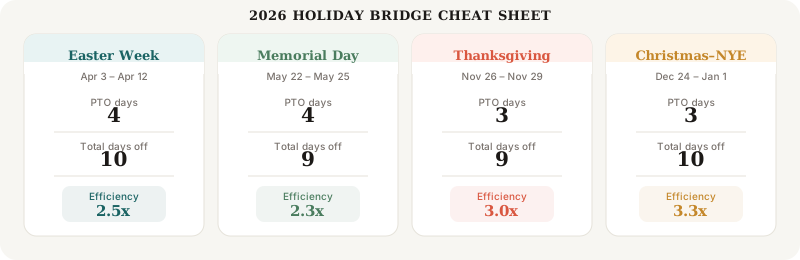
Here are the highest-efficiency windows this year for US workers:
Easter week (Apr 3–12): Take Mon–Thu off after Easter = 4 PTO days → 10 days off. Not every state observes Good Friday, but the surrounding weekends make this one of the year's best windows.
Memorial Day (May 22–25): Take the Tuesday–Friday before = 4 PTO days → 9 days off. Most flights are cheaper the week before Memorial Day than the weekend itself.
Thanksgiving (Nov 26–29): Take Mon–Wed before = 3 PTO days → 9 days off (through the weekend). This is the most popular bridge window in America for a reason.
Christmas to New Year's (Dec 24–Jan 1): Take Dec 29–31 = 3 PTO days → 10 days off. The highest-efficiency window of the year.
How to Find Your Best Windows
The math isn't hard, but it's tedious -- you need to cross-reference your state's holidays, check which day each falls on, and calculate the combinations. That's exactly what Leavewise does automatically.
Enter your PTO budget and your state, and it calculates every bridge window in your year, ranked by efficiency. Takes about 10 seconds.
Try it free at leavewise.co/optimize
One More Thing
The best time to plan is now, not when the holiday approaches. Flight and hotel prices spike 3–4 weeks before any major holiday weekend. If you know your optimal dates in advance, you book early and save twice -- once on PTO, once on travel costs.
Next Step
See your own best PTO windows
The article gives you the strategy. The optimizer gives you the exact dates for your year and your PTO balance.
Find my windowsGet the calendar and return when you are ready
Related topics
Useful tools
Related Articles
The Global PTO Gap: Why Workers Take Far Less Leave Than They're Entitled To
In most countries, workers leave a significant chunk of their paid leave unused. Here's the data on the gap between statutory entitlement and actual usage across 18 countries -- and what drives it.
How Long Is Lunar New Year? Public-Holiday Length by Country (and How to Leverage It)
A data comparison of how many statutory public-holiday days each country gives for Lunar New Year — China, Vietnam, South Korea, Singapore, Malaysia and Hong Kong — plus the make-up-weekend and substitute-holiday mechanics that stretch a 2–3 day holiday into a 7–9 day break, and how to leverage it with your own paid leave.
Which Countries' Workers Use the Least Leave? A Global Ranking of Unused Vacation Days
Japan, South Korea, and the US consistently rank among countries where workers leave the most vacation days on the table. Here's the data, the cultural forces behind it, and what it costs the global economy.