Building 9-Day Breaks: Why It Takes 4 PTO Days, Not 3
Fact-checked July 10, 2026 · 5 sourcesHow we verify
The most common mistake in vacation planning is treating paid leave as a rate — "I get 15 days, so I take 15 days off." Leave is not a rate. It is a lever. Placed against a public holiday, four leave days return nine consecutive days off — a payout of 2.25 days for every one you spend. Placed against four unremarkable Wednesdays, those same four days return exactly four. This post is about the difference between those two outcomes, and how to engineer the good one on purpose.
A correction up front. You will see the claim that three leave days buy a nine-day break. Around a single public holiday, that is arithmetically impossible — the true number is four. Three works only when two free weekdays fall in the same week. We show the derivation below, because the wrong number is the single most repeated error in this genre.
This is a research piece with cited sources. The leverage ratios here are arithmetic and stable. The specific holiday dates shift every year — and Korea's lunar holidays move on the Gregorian calendar — so we hedge all dates and hand the exact per-year math to the leave optimizer. Confirm current-year dates before you book.
The Anatomy of a 9-Day Bridge
A nine-day break is not a single block of leave. It is a sandwich: two weekends on the outside, a public holiday somewhere in the middle, and just enough leave days to fill the working gaps between them. The public holiday is the load-bearing wall. Without it, you are simply spending leave one-for-one.
The cleanest version runs from a Saturday to the following Sunday — nine calendar days end to end. Now count what is free. Nine consecutive days can contain at most four weekend days (two Saturdays and two Sundays — and only if the span starts on a Saturday). That leaves five working days inside the corridor. A single public holiday covers exactly one of them. So:
9 days − 4 weekend days − 1 public holiday = 4 working days you must buy.
That is the whole derivation, and it is why four is the floor. There is no arrangement of a single holiday and two weekends that gets a nine-day break for three leave days. Anyone selling you 3 → 9 is either counting a second free weekday or counting wrong.
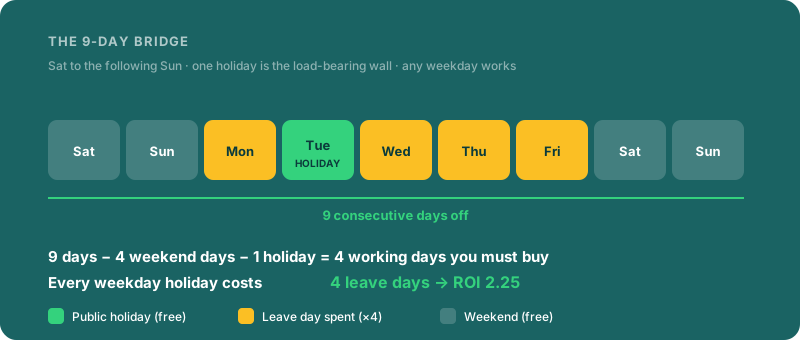
The arithmetic above never mentions which weekday the holiday lands on — and that is not an oversight. Any holiday falling Monday through Friday sits on one of the five working days in the corridor, so every weekday holiday costs the same four leave days for the same nine-day break. A Monday holiday buys nine days by bridging Tuesday to Friday; a Thursday holiday buys nine days by bridging Monday to Wednesday plus the Friday. The weekday changes which days you request, not how many. What the weekday genuinely changes is the price of the cheap plays — and that turns out to matter more than the nine-day case.
The Leverage Ratio: Days Off Per Leave Day
The single number that matters is the leverage ratio:
Leverage = (total consecutive days off) ÷ (paid leave days spent)
Spend four leave days around one public holiday, get nine days off, and your leverage is 2.25. Spend those same four days on four random Wednesdays with no holiday nearby and your leverage is 1.0. Same leave balance, more than double the time off. The table below shows how the payout depends entirely on where you place your days — and note that the nine-day bridge is not the highest-leverage move on the board.
| Placement | Public holiday? | Leave spent | Consecutive days off | Leverage |
|---|---|---|---|---|
| Unrelated mid-week days | None | 1 each | 1 each | 1.0 |
| Fri + Mon around one weekend | None | 2 | 4 | 2.0 |
| A whole week off, Mon–Fri | None | 5 | 9 | 1.8 |
| One bridge day beside a Mon/Tue/Thu/Fri holiday | Yes | 1 | 4 | 4.0 |
| Two days beside a Wednesday holiday | Yes | 2 | 5 | 2.5 |
| Three days beside any weekday holiday | Yes | 3 | 6 | 2.0 |
| Full bridge around any weekday holiday | Yes | 4 | 9 | 2.25 |
| Full bridge around a two-holiday cluster | Yes ×2 | 3 | 9 | 3.0 |
Two things jump out of that table, and both contradict the folk wisdom.
First, the single bridge day is the best buy on the board. One leave day next to a Monday, Tuesday, Thursday, or Friday holiday returns a four-day weekend — leverage 4.0, nearly double the nine-day bridge's 2.25. If you are optimizing raw days off per leave day, you should be collecting four-day weekends, not nine-day breaks. The nine-day bridge buys contiguity — a block long enough for real travel — and you pay for that in leverage. That is a legitimate trade, but it is a trade, not a free lunch.
Second, three leave days is a dead zone. Around a single holiday, three days buys six days off (leverage 2.0) — worse than stopping at two (2.5) and worse than pushing to four (2.25). The fourth leave day is the best marginal purchase in the whole exercise: it converts a six-day break into a nine-day one, three extra days off for one extra day of leave. If you find yourself about to spend three, spend two or spend four.
If you own roughly 15 leave days a year and spend them all at leverage 1.0, you get 15 days off. Spend them in a sensible mix of bridge days and full bridges and the same balance yields close to five and a half weeks away from work. That is the core argument in Turn 15 PTO Days Into 30 Days Off, applied to a single nine-day window.
What the Holiday's Weekday Actually Decides
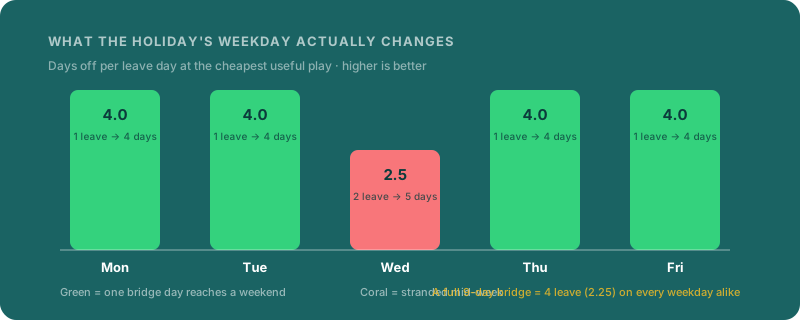
Public holidays are not interchangeable — but they are far more interchangeable than the usual advice claims. For the nine-day bridge, the weekday is irrelevant: every weekday holiday costs four leave days, as the table below shows. Where the weekday bites is the cheap end, and there exactly one weekday is a genuine dud.
Leave days needed for a nine-day break (Sat → following Sun):
| Holiday weekday | Working days you buy | Leave days | Leverage |
|---|---|---|---|
| Monday | Tue, Wed, Thu, Fri | 4 | 2.25 |
| Tuesday | Mon + Wed, Thu, Fri | 4 | 2.25 |
| Wednesday | Mon, Tue + Thu, Fri | 4 | 2.25 |
| Thursday | Mon, Tue, Wed + Fri | 4 | 2.25 |
| Friday | Mon, Tue, Wed, Thu | 4 | 2.25 |
Flat across the board. Now the cheap plays, where the weekday genuinely matters:
| Holiday weekday | Free, 0 leave | Best 1-leave play | Best 2-leave play |
|---|---|---|---|
| Monday | 3-day weekend | 4 days (take Tue) — 4.0 | 5 days (Tue–Wed) — 2.5 |
| Tuesday | weekend only | 4 days (take Mon) — 4.0 | 5 days (Mon + Wed) — 2.5 |
| Wednesday | weekend only | 2 days (Wed + Thu, adrift) — 2.0 | 5 days (Mon–Tue) — 2.5 |
| Thursday | weekend only | 4 days (take Fri) — 4.0 | 5 days (Wed + Fri) — 2.5 |
| Friday | 3-day weekend | 4 days (take Thu) — 4.0 | 5 days (Wed–Thu) — 2.5 |
- Monday or Friday holiday — the best case, not the worst. You get a three-day weekend for zero leave, and one leave day on the far side stretches it to four days (leverage 4.0). The common claim that Mon/Fri holidays are "wasted" is backwards: they hand you a free long weekend that a Tuesday holiday does not.
- Tuesday or Thursday holiday — no free extension, but the single adjacent bridge day (Monday before a Tuesday holiday, Friday after a Thursday one) also returns a four-day weekend for one leave day. Same 4.0 leverage as Mon/Fri; the difference is that here the bridge day earns you +2 days rather than +1, so the marginal return on that one request is the best available anywhere.
- Wednesday holiday — the only genuine dud. It is marooned in the middle of the week: one leave day gets you a stranded two-day break that touches no weekend, and you must spend two days (either side) just to reach a five-day break. If you are triaging a calendar, deprioritize Wednesdays.
So the honest ranking is: Mon/Fri ≈ Tue/Thu ≫ Wed for cheap plays, and a dead heat for nine-day bridges.
There is a second-order effect in countries with observed (in-lieu) holidays. In the US, when a federal holiday falls on a Saturday it is observed the preceding Friday, and a Sunday holiday is observed the following Monday (Executive Order 11582 / OPM). That mechanically converts a "wasted" weekend holiday into a long weekend — but it also means a holiday you were counting on to fall mid-week may get shunted to a Monday, collapsing your nine-day plan. Korea handles the same problem with substitute holidays (대체공휴일) that push a weekend holiday to the next working day. Either way, the observed date, not the nominal date, is what your bridge is built on. This is exactly why we refuse to hard-code dates and send you to the optimizer instead.
For a full ranking of which specific holidays carry the most bridge potential, see Ranking US Federal Holidays by Bridge Potential and the mechanics in The Bridge-Day ROI Formula, Explained.
A Worked Example: Four Leave Days, Nine Days Off
Let's build one concretely. Assume a public holiday lands on a Wednesday (we'll keep the date abstract, because it moves year to year).
The span: Saturday through the following Sunday — nine calendar days.
What's already free:
- Saturday + Sunday (opening weekend) — 2 days
- The Wednesday holiday — 1 day
- Saturday + Sunday (closing weekend) — 2 days
- Free subtotal: 5 days
What you must buy:
- Monday, Tuesday (before the holiday) — 2 leave days
- Thursday, Friday (after the holiday) — 2 leave days
- Leave spent: 4 days → leverage 2.25
Swap the Wednesday for a Tuesday holiday and nothing improves: you buy Monday, then Wednesday–Friday. Still four. Swap it for a Monday holiday: you buy Tuesday–Friday. Still four. The free subtotal is pinned at five (four weekend days + one holiday) no matter where in the week the holiday sits, so the bill is always four.
The one case where three really is enough
Three leave days can buy nine days off — but only when the corridor contains two free weekdays instead of one:
9 days − 4 weekend days − 2 free weekdays = 3 leave days. Leverage 3.0.
That happens in two real situations:
- Two adjacent public holidays, which is routine in Korea: Seollal and Chuseok are each three-day holiday clusters, so a well-placed Chuseok can leave you buying two days or fewer for a nine-day run. Christmas and Boxing Day do the same thing in the UK, Australia, and much of Europe.
- A holiday plus an employer-granted day. The classic US case: Thanksgiving always falls on the fourth Thursday of November (fixed by statute, so this one never rotates), and many employers hand out the Friday after. If your company gives you that Friday, buy Monday–Wednesday and you get Saturday-to-Sunday — nine days for three leave days. If your company doesn't, that Friday costs a leave day and you are back to four.
That distinction — a granted day versus a bought day — is exactly where the 3 → 9 claim usually goes wrong. Writers count the free Friday and forget it isn't free for everyone.
The single most important habit: before spending a leave day, check the weekday of the nearest holiday, and count how many free weekdays sit in the week. A leave day placed beside a holiday is worth up to four times a leave day placed anywhere else. The half-day PTO strategy squeezes even more out of the same idea by splitting a leave day across two long weekends.
The Same 4 Days Pay Out Differently by Country
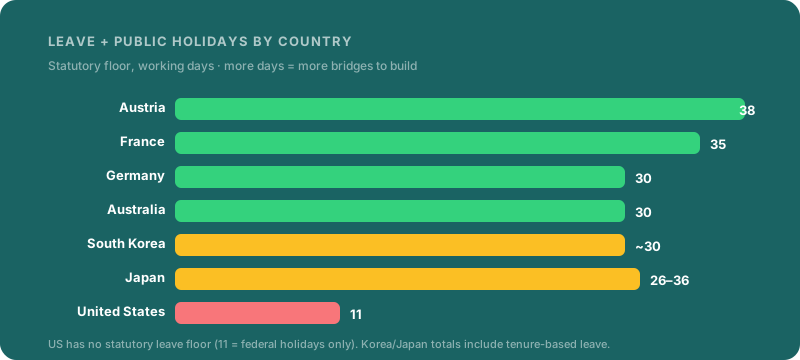
How many nine-day bridges you can build in a year is a function of two things: how many leave days you own, and how many public holidays your country gives you to anchor them to. Countries that combine a generous statutory leave floor with plenty of holidays — especially clustered ones — hand out more bridge opportunities than the raw leave number suggests.
| Country | Statutory paid leave (working days) | Statutorily paid public holidays | Combined total |
|---|---|---|---|
| Austria | 25 | 13 | 38 |
| France | 25 | 11 | 35 |
| Germany | 20 | ~10 | 30 |
| Australia | 20 | ~10 | 30 |
| South Korea | 15 (rising to 25 with tenure) | 15 base (~17 in 2026 incl. substitutes) | ~30–32 |
| Japan | 10–20 (with tenure) | 0 statutory (~16 customarily paid) | 10–20 statutory; ~26–36 in practice |
| United States | 0 (no federal minimum) | 0 private-sector mandate (11 federal, for federal employees) | 0 guaranteed; 11 for federal workers |
Sources: Wikipedia's List of minimum annual leave by country (aggregating statutory sources); Korea Labor Standards Act Article 60; OPM federal holidays. Totals are statutory floors — most employers offer more, and public-holiday counts vary by region (German Länder, Australian states, Korean substitute holidays).
Two rows need asterisks. Japan: its ~16 national holidays are widely observed as paid days off in practice but are not mandated as paid by the Labour Standards Act, so its statutory floor is just the 10–20 leave days. United States: the 11 federal holidays are a floor for federal employees only — no US law requires a private employer to give any paid holiday or any paid leave at all. The commonly cited "11" is not a floor most American workers actually stand on; it's a convention their employer chooses to follow.
Two takeaways for the nine-day bridge:
- The US is the outlier. With no statutory leave floor and no private-sector holiday mandate, the average American worker has the fewest raw days to work with — which is exactly why leverage matters most there. Getting four of your scarce days to return nine off is worth more, proportionally, than it is to an Austrian sitting on 38.
- Korea's structure is genuinely bridge-friendly — and it is the one place 3 → 9 is routine. Fifteen statutory leave days plus fifteen public holidays would be unremarkable on its own; what makes Korea different is that Seollal and Chuseok are each three-day clusters. Multiple free weekdays in one week is precisely the condition that pushes leverage past 2.25 toward 3.0 and beyond. A Korean worker who plans around those two clusters and the substitute-holiday rules can chain several nine-day breaks a year for well under four leave days each. But because both follow the lunar calendar, their weekday changes every year, so date-checking is non-negotiable.
The Yearly Budget: Planning Around Scarcity
Once you accept that a leave day's value depends on placement, planning becomes a budgeting problem. Sketch the year's holidays, throw out the Wednesdays, and decide how much contiguity you actually want to buy. That is the real trade: four-day weekends maximize total days off (4.0), nine-day bridges maximize block length (2.25). You cannot have both.
A rough allocation for someone with ~15 leave days and a typical calendar of ~10 holidays:
- 8 days → two nine-day bridges (4 leave each) around the two holidays you most want to travel on. Leverage 2.25. Yields 18 days off.
- 4 days → four four-day weekends (1 bridge day each) beside Mon/Tue/Thu/Fri holidays. Leverage 4.0. Yields 16 days off.
- 2 days → one five-day break around a Wednesday holiday, if a good one exists. Leverage 2.5. Yields 5 days off.
- 1 day → buffer, or a half-day split.
That is 15 leave days converted into roughly 39 days off across seven separate blocks — a blended leverage of about 2.8, and the difference between "I used all my vacation" and "I was off for five and a half weeks." It assumes seven suitably placed holidays; with fewer, the long tail of four-day weekends shrinks first. Note that tilting the mix toward the nine-day bridges lowers the total: three bridges plus three bridge days (15 leave) yields 27 + 12 = 39 as well, but four bridges (16 leave) would yield only 36. Length costs days. The exact windows depend on the current year's calendar, which is precisely what the optimizer computes for you.
FAQ
Can I really get 9 days off from only 3 leave days?
Not around a single public holiday — that is arithmetically impossible, and the claim is the most common error in this genre. Nine consecutive days contain at most four weekend days, leaving five working days; one holiday covers one of them, so four must be bought. Leverage 2.25, not 3.0.
Three leave days is only enough when two free weekdays fall inside the corridor: two adjacent public holidays (Korea's Seollal and Chuseok clusters, or Christmas plus Boxing Day), or one holiday plus a day your employer grants you (the Friday after US Thanksgiving, if your company gives it). If you have to spend leave on that Friday, you're back to four.
Isn't a nine-day bridge the best use of my leave?
Not if you're counting days off. A single bridge day beside a Monday, Tuesday, Thursday, or Friday holiday returns a four-day weekend — leverage 4.0, nearly double the nine-day bridge's 2.25. The bridge buys you an unbroken block long enough for real travel, and you pay roughly two days of leverage for it. Worth it for a trip to Osaka; wasteful for a staycation. Decide which you're buying.
Which weekday should I hunt for?
For a nine-day break, it genuinely does not matter — Monday through Friday all cost four leave days. For everything shorter, avoid Wednesday: it's the only weekday where one leave day can't reach a weekend, so the cheapest useful play costs two days for a five-day break. Monday and Friday holidays are quietly the best deal on the calendar, since they hand you a three-day weekend for nothing at all.
Why does the same holiday give a great bridge one year and a poor one the next?
Because the date is fixed but the weekday rotates by one or two each year. A holiday on a Thursday this year may be a Saturday two years later — and a weekend holiday is the one genuinely bad outcome, since it collides with days you already had free. In the US that Saturday gets observed on the preceding Friday; in Korea a weekend holiday triggers a substitute day on the next working day. Both rescue it into a long weekend. The nominal date tells you almost nothing — the observed weekday tells you everything. Always run the current year through the leave optimizer.
Does this work in the US, where there's no statutory paid leave?
Yes, and it matters more there. US workers have no federal leave floor, and no law requires a private employer to give any paid holiday at all — the 11 federal holidays are a floor only for federal employees. Each leave day is correspondingly scarcer, so turning four scarce days into nine off is a bigger proportional win than it is for a European worker with 25+ statutory days. The mechanics are identical: find a federal holiday your employer actually observes, bracket it with two weekends, and buy the four working days in between.
Should I book flights before or after confirming the bridge?
Confirm the bridge first. The nine-day corridor depends on the holiday's observed weekday and, in Korea, on whether a substitute holiday applies — details that shift year to year. Lock the calendar math in the optimizer, request the leave, and only then commit to non-refundable travel. Booking against a nominal date you assumed was mid-week is the most common way these plans fall apart.
Sources
- OPM — Federal Holidays — the 11 US federal holidays and weekend-observance rule.
- OPM — Federal Holidays "In Lieu Of" Determination — how Saturday/Sunday holidays are observed on adjacent workdays.
- List of minimum annual leave by country — Wikipedia — statutory leave + public-holiday totals aggregated from national sources.
- Korea Labor Standards Act, Article 60 (Annual Leave) — 15-day minimum, tenure accrual, 25-day cap.
- Euronews — How to use public holidays to maximise annual leave — the bridge-day concept and cross-country leverage examples.
Next Step
See your own best PTO windows
The article gives you the strategy. The optimizer gives you the exact dates for your year and your PTO balance.
Find my windowsGet the calendar and return when you are ready
Related topics
Useful tools
Related Articles
The Bridge-Day ROI Formula, Explained: How to Measure Days-Off-Per-Leave-Day
A data-driven breakdown of bridge-day ROI: the days-off-per-leave-day formula, why Tuesday and Thursday holidays outperform Mondays, and how to rank every leave day you own. Worked examples for the US, Korea, and Europe.
The Best Bridge Years, Ranked: 2027–2030 for Squeezing Days Off (US + Korea)
A data-driven ranking of 2027, 2028, 2029, and 2030 by how much time off you can build from a fixed pool of paid leave. We score each year on weekday alignment, weekend-loss, and bridge-day leverage for the US federal calendar and South Korea's holiday system.
The Holiday Deserts: Which Months Have the Fewest Public Holidays — and How to Spend PTO There
A data look at which calendar months have the fewest public holidays in the US and South Korea, why April, July and August are 'holiday deserts,' and the PTO strategy that turns those empty months into your cheapest long weekends.